Showing posts with label old stuff. Show all posts

Sunday, June 8, 2014

Crappy Old Stuff 14th Edition

One of my favorite quotes:
Vocabulary and success go hand in hand. Investigation has shown that the man with a large number of words at his command is the one who comes to lead and direct his fellows. Through his knowledge of words, through his ability to make them express the exact shade of his meaning, he gives to his ideas real power.
-- John C. Hodges
[My emphasis]

I walked into to the 50 ₵ room at the Stargvegas library the other and walked out $16.50 poorer. Oddly, most of the 33 books were neither crappy nor especially old.

See? There's William Shatner and Princess Grace and that economist dude and some Christmas stories. Hey! Daughter C! That art book is beautiful.
One (not pictured) is the fourteenth-- 2001-- edition of Harbrace Handbook of English by John C. Hodges (et al.) first published in 1941. Though some chapters are slightly renamed in the newer edition, the presentation order remains the same. The quote above comes from Chapter 19, "Good Use" (1941), "Good Usage" (2001).

Thumbing through the Preface of my new book, I see that Chapter 19
has been extensively rewritten to help students write positively to and about all people. It now offers advise not only about handling matters of gender in language, but also about including members of all races, classes, ages, and orientations.
Isn't that nice? 

Left 1941; Right 2001
As you can see, the page sizes are approximately the same, although the font sizes are not-- 2001's are smaller. Not including the index, the crappy old book has 404 pages. The somewhat less crappy newer book (there are now, in 2014, eighteen editions) has 797. Both books deal with the grammar, mechanics, punctuation, elements of style,* and larger elements of the paragraph, papers and letters-- things that are pretty basic.

Now I ask you, why in the world does the 2001 edition need to be 97% longer than first edition? 

Left 2001; Right 1941

Because the coauthors of the fourteenth edition, Suzanne Strobeck Webb, Robert Keith Miller, and Winifred Bryan Horner did not read chapter 21, Wordiness, in the first edition. 

* Below the fold

Saturday, May 31, 2014

Mayfest Meanderings

So one thing led to another today and we wound up at Mayfest-- a celebration of the founding anniversary of a little town down the road.


As a GRIT, this offended Miss M. Here's my counter: Look how fat that's lady's thighs are! She's trying real hard to be Southern. 


And then we stopped in at the junk/"antique" stores on our way home.

WE SCORED.


This is real wood. Not that flimsy teaky stuff.
:-) Life is weird. 
We already have this. And Miss M has more.


Picnic!

Thursday, May 29, 2014

To My Dear Husband: The Quest

The book, whose inscription has garnered a fair amount of attention here on the blog, is The New Quest by Rufus M. Jones (1928).

Jones was a Quaker:
Rufus Jones (writer) 
Rufus Matthew Jones (January 25, 1863 – June 16, 1948) was an American writer, magazine editor, philosopher, and college professor. He was instrumental in the establishment of the Haverford Emergency Unit (a precursor to the American Friends Service Committee). One of the most influential Quakers of the 20th century, he was a Quaker historian and theologian as well as a philosopher. He is the only person to have delivered two Swarthmore Lectures.
This particular book was discarded by the Sanders Memorial Library of Clarke College, Newton, Mississippi and somehow made its way to the Palmer Thrift Shop in Starkville, Mississippi where I purchased it for $0.50. (Books are 1/2 price lately.)

We should all be Quakers. 

May Mrs. Thomas Lockhart and her Dear Husband rest in peace knowing that her Christmas gift to him has at last found a deserving home.

Thursday, April 17, 2014

"The Kiss of Betrayal"

Lots going on today!
Since tomorrow is Good Friday, lots of businesses and such will be closed-- even State!-- so today substitutes for Friday-go-to-town-day. But first I have to get the first coat on. But before that I must post at least a little something. So I turned to a crappy old book, Christ and the Fine Arts, for inspiration. 

Perfect.
There's a nice little commentary to quote. But before I do that, I need to find the color version of this painting. Easy-peasy, right?

How sad is this?
Three search engines later-- including duckduckgo.com which claims to never track anyone-- and I give up. I've got things to do. 

Christ and the Fine Arts Revised and Enlarged Edition: An Anthology of Pictures, Poetry, Music and Stories Centering in the Life of Christ. Cynthia Pearl Maus. Harper & Row, Publishers, New York. 1959.

Thursday, April 10, 2014

The Season of Promise and Hope and New Life

My latest Books Bygone column is out in our little newspaper. Also available here-- along with all of the others! Take a look!

It begins: 

Long, long ago, in a time far, far away—that would be before the days of Pinterest—crafty souls got their creative inspiration from magazines and books. These “idea” books often focused on a specific season or holiday and provided not just ideas but also step-by-step illustrated instructions on how to make, for example, an adorable Easter Bunny Centerpiece using little more than paper towels, crepe paper, and paste. As Easter is “the season of promise and hope and new life” which “each of us wants to celebrate in the spirit of love and kindness,” I’ve begun to look through the Easter Idea Book (1954) for inspiration.

Monday, April 7, 2014

"The Importance of Reading"

The reading of good books is one of the most helpful ways in which young people can develop themselves. One of the saddest mistakes I made in years gone by was utter neglect of reading. I now realize what I have missed by not having read and studied more. 
... [I]t is a spendid thing to make money, but it is a greater thing to make a good way of life. If [you] will devote some time each day to reading the best books [you] can find [you] will derive a lasting benefit throughout [your] lives. 
--J.C. Penney, Lines of a Layman (1956)

Thursday, April 3, 2014

A Crappy Old Book about a Crappy Old Magazine

Field & Stream Treasury: Memorable Articles and Stories From the Pages of America's Number One Sportsman's Magazine (1955)
I'm cleaning my desktop. It tends to accumulate a lot of crappy old books that either need to be returned to their homes or find homes somewhere besides my desk.

I'd forgotten all about this one which I picked up last Friday at the Book Mart in downtown Starkvegas. You remember the Book Mart-- 
I was puzzled by the arbitrary pricing, but I gathered up my two little crappy old books-- leaving Madame Currie: A Biography by Eve Curie (1939; on sale for $29) and The Ultimate T-Shirt Book: Creating Your Own Unique Designs (1998; $14.95) on the shelf and headed downstairs to the cash register. 
"That will be $7.49, ma'am," the well-mannered young man informed me.
My articulate response was, "Huh?"
"The prices on these old used books don't mean anything. We discount them."
I asked what system-- what percentage-- was taken off because a 2/3 discount seemed rather odd, I was told there was none. He just looks at the book and how old it is and how yellow the pages are and decides on a price. This is a change since I'd last been in the bookstore.
"Hang on a minute," I said as I ran back upstairs. 
I'm all for free-wheeling capitalism, but this pricing system strikes me as a bit arbitrary.
Typically I file books about sports under the Sports section in the Bunkhouse. But this one is such a gem I think I'll try to keep it handy.

I should do a post on politically incorrect advertising. I've got more than enough material.

And now, to find places for Toynbee's Mankind and Mother Earth: A Narrative History of the World (1976; published posthumously) and Bennett's The De-Valuing of America: The Fight for Our Culture and Our Children (1992).

Wednesday, April 2, 2014

Good vs. Bad

What we most need to know about any man is surely this: whether he is good or bad. To be sure, we seldom put the question so crudely. Indeed we often affect a scorn for mere goodness, persuading ourselves that we are more concerned with a man's breeding, his intellectual vigor, his artistic skill or his practical efficiency, but in the end we admit, implicitly or explicitly, that we are more deeply interested in his honesty, his courage and his justice-- in a word, in his goodness-- than in his intellectual or creative endowment, his upbringing, or his possessions. All this amounts to saying that the most significant way of grouping human beings is as good or bad.

The Good Man and the Good: An Introduction to Ethics, 1918.

Wednesday, February 26, 2014

A Few Good Books

The Tower

in no particular order
UPDATE (7:40am): Something's wrong. Things aren't looking as they should. I'm working on it.

Part of the fun of collecting old books is in the finding of old books. Part of the fun in that is poking around different corners of the world, discovering what each has to offer. (I once discovered a copy of Eats, Shoots & Leaves-- why commas really do make a difference-- in a used book store just off Semmelweis Ut. in Budapest. Great book. Gave it away. Haven't found another copy since.) In this regard, Jonesboro was a disappointment. Usually there's a local flair to the offerings. If there was one in northeast Ark. I failed to appreciate it.

The seven Poli-Sci books were free-- picked up from a "Free Books" table to which A. Leland drew my attention in Memphis. Most of the remainder were from a Palmer Home type charity store called "Abilities" in downtown J'boro. Not that they each weren't worth $0.50 but... Ho Hum.

Monday, December 30, 2013

BOOKS: "A Nobler and Fuller Life"

One of the most important services the school can render the child is to bring him in touch with the world of books. In these the great minds of the past have expressed the insight into life which they possessed, and have done so in such as way that the manner of expression is almost as priceless a heritage as the insight itself. Great book stir the reader to a nobler and fuller life. They are the means by which society hands down to future generations whatever of good it has discovered or proved. ... The better class of reading books is no longer made up of information lessons on every conceivable topic, but of selections from the realm of pure literature.
[My emphasis. Literary Readings: An Introduction to the Study of Literature. Charles Madison Curry. Rand, McNally & Company, Chicago. 1903.]

And with that, I present to you-- without comment-- the 2011 Summer Reading List from Jackson, Mississippi public schools. (2013's general list for grades 6-12 was the same.) I've added original publication dates (in pink).


By the way-- there's an OPPOSE COMMON CORE RALLY at the Capitol in Jackson on January 7 from 8:30am - 10:30am.

Thursday, December 19, 2013

A Nice Little Find

I stopped in at Palmer Home Thrift Store the other day and just happened to walk by the Christmas item table.

Heh. That looks like the real thing.
Indeed.
I figured I could spare $0.50-- that's fifty cents-- for a piece of Spode. 

I found a couple of other $0.50 items-- crappy old books-- and proceeded to the checkout counter with $3.21 in my sweaty little hands. (I like doing that. The ladies there are nice but math is not their strong suit. They always seem surprised that I know my 7s tables.) 

$2.94

Huh?

The Christmas merchandise is 1/2 off. 

It would be less than thorough to blog about my $0.25 piece of Spode without asking what sort of deal I really got.

eBay. It's only $89.95 at Replacements.

Wednesday, December 11, 2013

Preserving Western Culture one 50-cent Book At A Time

"Ecce Ancilla Domini" by Rossetti (downloaded from fromoldbooks.org)*
Books are on sale at Palmer Home again. I brought home $6 worth and made an involuntary contribution of $0.42 to the coffers of the Sovereign State of Mississippi. Several were of a religious nature.

The Screwtape Letters, C.S. Lewis (The Macmillan Company, New York, 1943). I'll be reading this over a few winter afternoons.

Poets and Puritans Third Edition, T.R. Glover (Methuen & Co. Ltd., London, 1923, orig. 1915). All the usual suspects-- Spencer, Milton, Bunyan, et al.-- but as I don't know too much about the usual suspects, this will come in handy.

Monser's Topical Index and Digest of the Bible, Harold E. Monser, ed. (Baker Book House, Grand Rapids, Michigan, 1960, orig. 1914).  This was an amazing find. A. Leland offered me real cash money for it. Not a chance! I may write about this in the future.

The one from which the picture above does not* come is Christ and the Fine Arts Revised and Enlarged Edition: An Anthology of Pictures, Poetry, Music and Stories Centering in the Life of Christ, Cynthia Pearl Maus (Harper & Row, Publishers, New York, 1959, orig. 1938). "No Sunday School can be complete without this book." It contains 76 stories, 256 poems, 117 hymn interpretations, 100 art interpretations, and 100 art reproductions-- all in black & white!

As it is the Christmas season, I thought it appropriate to look through the section on the Annunciation and Nativity. It begins with with a (black and white) reproduction, and interpretation, of the  painting "Ecce Ancilla Domini."
Among the many beautiful painting of the Annunciation few,  if any, possess greater spiritual appeal than Rossetti's "Behold, the Handmaid of the Lord."
A fair bit of the interpretation is actually descriptive-- we have to know what color the curtain is in order to appreciate that it suggests "the ideal of truth which has been preparing Mary to be a fine woman since her girlhood." Likewise, the red loom is the color of Divine love. The white lilies of the loom "tell of the purity of [Mary's] thoughts and deeds."

I should make a concerted effort to know a little more about art. Maybe I'll keep my eyes peeled for crappy old art books.
~~

* And now... to the asterisk. www.fromoldbooks.org is going to become one of my favorite web sites-- I can just feel it. I can't believe I found it just today searching for a color image of
"Ecce Ancilla Domini."
About fromoldbooks.org
I have lots of old and antiquarian books, and many of them have got really neat pictures in them even if they are not very valuable or expensive books. I thought it was a shame that no-one but me could see them so I started putting them online.

I also collect old dictionaries, and over the years I've typed (and later scanned) some of the dictionary entries.

I am not a book-seller. I do not buy books to make money by selling them.


...

I use an Epson E10000XL museum-quality flat-bed scanner together with xsane and GIMP on GNU/Linux[tm].

This is a hobby, a private interest site.
 See what I mean? Old dictionaries! GIMP! 

 Check out the site. It's searchable. Most of the images are free although Liam, the site's proprietor will not turn down a donation.

Friday, December 6, 2013

Books Bygone

What I do when I'm not blogging and eating bon bons.
The editor of our local weekly newspaper has given me the opportunity to become a famous writer! Notice that I did not say "rich and famous writer." He will be happy to publish my little essays-- as space allows-- for free. But, hey, famous writers have to start somewhere.

Each essay focuses on one or two crappy old books. I poke a little fun-- because it's hard not to-- but I also try to highlight the value and worth of these crappy old books and the times they record. In short, to share my love of them (even though that sounds dopey).

Believe it or not, our little weekly newspaper has an online presence! Check it out.
Books Bygone: May I introduce my friends?

Books Bygone: 'The Modern Family Cookbook'

Books Bygone: Pride of Ownership (not yet online)
If you're a City Mouse, take a few minutes to poke around the rest of newspaper-- you'll see how people really live out here in flyover land and what matters to us. Who died? Who's getting married? Who welcomed their first child? Who got arrested? Who needs help? Who are we proud of? Crappy old stuff like that. 

H/t A. Leland for coming up with "Books Bygone." And a big thanks to all who will link to the essays. I mean, I can't be famous if no one reads my stuff!

Monday, November 25, 2013

A Lunchtime Trip

from Starkvegas, Mississippi to Oxford, not-Mississippi via Poland, Berlin and South Africa
We begin our little journey with the recent announcement that Donald "Field" Brown, a Mississippi State student double majoring in English and Philosophy, has been awarded a Rhodes Scholarship! The Rhodes Scholarship was established at the behest of Cecil Rhodes.

That name sounds familiar.
Cecil Rhodes: Man and Empire-Maker. Princess Catherine Radziwill. Funk and Wagnalls Company, New York. 1918.
Sure enough, there it is right on the shelf behind my desk/lunch table-- British rule of South Africa, which would explain where ol' Cecil got his money. Mining.

So who is this Princess? My minimal skimming of the book suggests she's not the most objective author, but what do I know? It's lunchtime and I am not predisposed to go wandering about searching for biographical information, so I turn to that infallible source, Wikipedia:
Princess Catherine Radziwiłł (30 March 1858 – 12 May 1941) was a Polish princess from the Polish-Lithuanian aristocratic Radziwiłł family. She was born as Countess Ekaterina Adamovna Rzewuska. She married Prince Wilhelm Radziwiłł at age 15 and moved to Berlin to live with his family.

And then it gets interesting:
She stalked the English-born South African politician Cecil Rhodes and asked him to marry her, but he refused. She then got revenge by forging his name on a promissory note. She was convicted of forging Rhodes' signature and spent time in a South African jail for her crimes.
Enough about the miner & the Princess. Back to Oxford-- not-Mississippi, the Oxford across the pond-- where Field will be studying.
Brown, the son of Willie and Cynthia Brown, said he is particularly interested in studying post-World War II African-American literature. He said both English and philosophy are related to his love of studying ideas.

"English is the narrative form; literature deals with everyday people and how they relate to ideas," Brown said. "Philosophy is the systematic study of ideas, and the two go together."

Brown said that, while the promise of continuing his studies at Oxford is thrilling, the reality of gaining the fellowship is life changing.

"So many great minds have walked the halls of Oxford, including tons of writers and a lot of important thinkers who have shaped the western world," Brown said.

Brown said he plans to pursue masters of studies degrees in both American literature and modern English literature. Specifically, he is interested in trans-Atlantic interactions within literature, particularly how McCarthyism scare tactics of the 1950s and the Cold War affected which books were promoted.

Wednesday, November 20, 2013

Civility, con't

Isn't this silly?
I mean really-- look at all of those dishes I'm going to have to do by hand tomorrow morning. And whose bright idea was it to think that when folks arrive home from school & work they'd want to just hang around a table and nibble and chat before they dress for dinner? What a crappy old idea.

But go figure! They seemed to enjoy it. (And I won't really mind doing those few dishes.)

Monday, October 28, 2013

Coincidence? Fate? Destiny? Divine Intervention?

Or none of the above?

Thomas Babington Macaulay
I only took one crappy old book with me on our Texas adventure, my little book of books, The Guide to Reading: The Pocket University Volume XXIII (Lyman Abbott, Asa Don Dickinson et al., eds., Nelson Doubleday, Inc., Garden City, New York, 1925). This is the little book that suggests daily 15-30 minute readings. Macaulay is featured in both the readings and the two lengthy introductions. Prior to October 26, 2013, I'd come across Macaulay's name while reading up on British history, so I knew him to be a historian, but I did not have any of his works.

And then... on October 26, 2013, I stumbled upon the crappy old volume pictured above in the antique store in Slaton, Texas!

Relaxing, back at our room, Mr. Big Food asked about the book I'd purchased. Then, seeing that I was reading my little book of books, he ask what the readings for the day were. I turned to "October 22nd to 28th" and something on the page caught my attention.

OMG!! 

Thomas Babington Macaulay was born October 25, 1800!! Just yesterday!!

What are the odds of my finding a volume of Macaulay's The History of England the day after his birthday?

About 1 in 365, I think. 

Thursday, October 17, 2013

Call Me Up! (updated with citation)

From Whys and Wherefores, William Dodge Lewis and Albert Lindsay Rowland, The John C. Winston Company, Chicago &c., 1930.

You are in the 5th Grade. You have forgotten what the arithmetic assignment is. What can you do about it?

If you have a telephone... . Does this presume that if you do not have a telephone, you're screwed on your arithmetic assignment?
See. The makers of technology always want you to think you are screwed if you don't have their technology. If you don't have dictionary.com on your phone, you'd not have been able to pull up the definition of anathema and save A. Leland from making a definitional mistake. Therefore, having dictionary.com on your handheld or mobile device is necessary. False.

"This is Margaret speaking."
Ah yes. Those were the days.

Red hair.

Let's bring back courtesy to the pocket dial. "I'm ever so sorry to have intruded. It was a pocket dial. Good day!"
"The telephone companies prefers this." No kidding. And all the easier to record you.

Monday, October 14, 2013

Christoforo Colombo Part 1: #9

No. It's not an obsession. It's a mission.
Michael H. Hart's The 100: A Ranking of the Most Influential Persons in History has good ole' Christopher Columbus as the ninth most influential person in history behind Muhammad, Isaac Newton, Jesus Christ, Budda, Confucius, St. Paul, Ts'ai Lun, and Johann Gutenberg. 

The 100 was published in 1978 by Hart Publishing Company. The book and its author was and are controversial for a number of reasons, not the least of which are the ranking of Muhammad higher than Christ, and the author's view that the United States should be "partitioned" into three nations. 

Setting those issues aside, here's what Hart says about Columbus:
It is obvious that Columbus's first trip had a revolutionary impact upon European history, and an even greater effect of the Americas. The one date that every schoolchild knows is 1492. Still, there are several possible objections to ranking Columbus so high on the list.
(Is it still true that every schoolchild knows the significance of 1492?)

Objection The First: "Columbus was not the first European to discover the New World." Lief Ericson (among others, I'll add) had long before. Hart counters that Ericson was historically unimportant. News of his discovery was not widespread but "within a few years of [Columbus's] return ... many additional expeditions to the New World were made and conquest and colonization of the new territories began."

Objection The Second: Someone was bound to discover America someday, what's so great about Columbus? Hart argues true enough but 1) "subsequent developments" in the New World would have taken a different trajectory had the Americas been discovered by, for example, the French and 2) Columbus actually "did discover America."

Objection The Third: Every educated European already knew the Earth was round-- Aristotle said so. Hart gets around this objection by asserting that may well be, but Columbus didn't show the Earth was round, he discover America and no 15th century Europeans-- and certainly not Aristotle-- "had any knowledge of the existence of the American continents."

Hart's concluding remarks about Columbus:
Columbus's character was not entirely admirable. He was exceptionally avaricious; in fact, one important reason that Columbus encountered difficulties in persuading Isabella to finance him was that he drove an extremely greedy bargain. Also, though it may not be fair to judge him by today's ethical standards, he treated the Indians with shocking cruelty. This is not, however, a list of the noblest characters in history, but rather of the most influential ones, and by that criterion Columbus deserves a place near the top of the list.

Tuesday, September 24, 2013

46 Pages

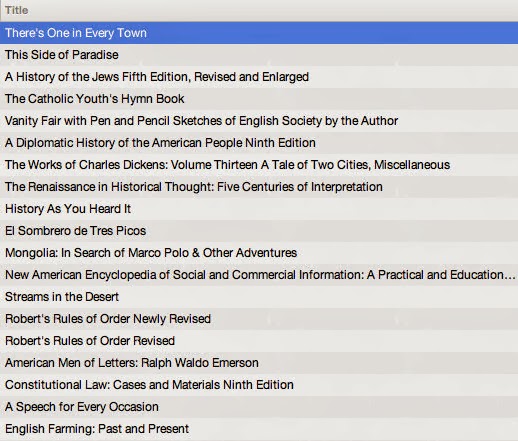
It has been 40 days since I've posted about a purchase-- not to be confused with a gift-- of crappy old books. During those 40 days, I have acquired 48 crappy old books.

Check out those two Robert's Rules books! In all my years of scouring crappy old book and junk stores, I had never come across Robert's Rules of Order before and then... boom! I found the Revised edition (1915) in town on the 18th and the Newly Revised (1970) in Tupelo on the 19th. If ever we need to bring order to the Farm, we're set!

Don't worry about those last four entries, I'm not going continental. I found those and the other philosophy books (above & below) in a box on the floor of a hallway. Free.

That War Department book (1929) is interesting. You can contact your commander, take a test on the book's content, and if you pass, receive a certificate!
The crappy old book book to which the post title alludes is History As You Heard It by Lowell Thomas (Doubleday & Company, Inc., Garden City, N.Y., 1957).

Do you recognize Mr. Thomas?
Some of you may have heard of Mr. Thomas. Indeed, some may have heard him! For those such as I, who have a vague "sounds sort of familiar" feeling, here are a few snippets of the Wikipedia entry on him.
Lowell Jackson Thomas (April 6, 1892 – August 29, 1981) was an American writer, broadcaster, and traveler, best known as the man who made Lawrence of Arabia famous. So varied were Thomas's activities that when it came time for the Library of Congress to catalog his memoirs they were forced to put them in "CT" ("biographies of subjects who do not fit into any other category") in their classification.[citation needed]


In 1930, he became a broadcaster with the CBS radio network, delivering a nightly news and commentary program. After two years, he switched to the NBC radio network but returned to CBS in 1947. In contrast to today's practices, Thomas was not an employee of either NBC News or CBS News. Prior to 1947 he was employed by the broadcast's sponsor, Sunoco. When he returned to CBS ... he established an independent company to produce the broadcast which he sold to CBS. He hosted the first-ever television-news broadcast in 1930 and the first regularly scheduled television news broadcast (even though it was just a simulcast of his radio broadcast), beginning on February 21, 1940, on NBC.[5][6] But the television news simulcast was a short-lived venture for him, and he favored radio. Indeed, it was over radio that he presented and commented upon the news for four decades until his retirement in 1976, the longest radio career of anyone in his day (a record later surpassed by Paul Harvey).
History As You Heard It (1957) is 

 
"a daily chronicle of the years between 1930 and 1955, a collection of excerpts from the news broadcasts of Lowell Thomas." 


 I skimmed through 46 pages, from June 22, 1933 and the Hiterlites attempt to abolish the Old Testament, to December 2, 1936

and rumors of poor King Edward VIII's abdication. [I still think they should have named the kid Edward.]
For your ... -- "amusement" doesn't sound quite right, given what was going on in the world  '33-'36 does it?-- . I've got it! Here are some crappy old news events that portended of things to come (although some news is amusing).
October 27, 1933-- The Secretary of the Interior, Mr. Ickes, produces video praising Islam's contribution to women's rights  [sorry that was yesterday's news] ... announces today a Federal Housing Corporation is going to be established.
March 5, 1934-- It seems almost unbelievable that Dillinger could have escaped so soon after he was put in prison. ... The fact that he escaped by means of a pistol carved with razor blades out of a piece of wood caps the climax of incredibility.

October 22, 1934-- They got Pretty Boy Floyd, the last of the Dillinger big shots. In Iowa, Federal agents dropped Pretty Boy with a well-aimed bullet, so that he crept away into a thicket like a wounded animal. Now comes the last word, the would was mortal. They found him dead.